
Article content
“We play a role in filling those gaps, which, if we weren’t here, patients would have nowhere else to go,” Pillay said.
Article content
The ideal situation would be that there aren’t as many shortages, Pillay explained.
Article content
But in the meantime, he says Ottawa’s growing compounding pharmacy practices are stepping in where needed.
Article content

Article content
Compounding pharmacists feel pressure
Article content
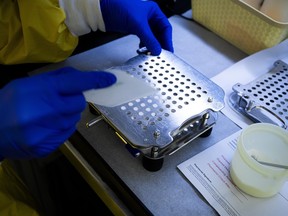
Pillay says he has three dedicated employees who only do compounding work full-time at his pharmacy in the Glebe.
Article content
“They spend all day just making (medications) because we supply not only to our own patients, but patients from other pharmacies that refer people to us for those compounds because they aren’t able to do it.”
Article content
It’s a testament to the pressures compounding pharmacies are witnessing as drug shortages continue to persist province-wide, Pillay says.
Article content
“It adds to our workload and pressure (because) sometimes patients need (medications) very urgently because they’re not available (commercially),” he said. “We kind of have to juggle our schedule around to try and accommodate.”
Article content
Despite the added pressure, Pillay says compounding pharmacies are in a “unique position” to provide more alternatives than a pharmacy that doesn’t compound.
Article content
Article content
Article content
Pharmacists in the middle
Article content
Pharmacists spend up to 20 per cent of their time managing drug shortages, according to Canadian Pharmacist Association chief pharmacist officer Sadaf Faisal.
Article content
“If you look at Health Canada’s drug shortage website, at any given time, you can see that there could be up to 2,000 active drug shortages,” Faisal said in an interview.
Article content
But not all of them actually reach the public consciousness.
Article content
“(This is) because pharmacists are working in the background trying to find out alternative solutions,” Faisal added.
Article content
“This means pharmacists will contact the prescribing doctor to get the medication covered.”
Article content
Should pharmacists have a wider scope of practice?
Article content
Faisal explained that in some jurisdictions across Canada, pharmacists are able to suggest an alternative drug if the prescribed medication is commercially unavailable.
Article content
This expanded scope of practice is another viable solution to ease and better manage drug shortages in the province, she said.
Article content
“If one medication goes on shortage, your pharmacist … will be able to work with your provider so your prescription can get switched,” Faisal said.
Article content
Article content
Ontario and Manitoba are the only provinces in Canada where pharmacists aren’t able to make this suggestion.
Article content
While earlier this year, Ontario announced it would allow pharmacists to administer vaccines for six different diseases and prescribe for nine “common ailments,” Faisal says one of the national association’s advocacy goals is to get Ontario pharmacists the ability to suggest alternative drugs for products experiencing a shortage.
Article content
Article content
Moving forward
Article content
For those like Proulx, the anxiety coupled with drug shortages is only the tip of the iceberg of the pre-existing pain and fatigue from living with a long-term illness.
Article content
Proulx says she witnesses dozens of people like her who experience the uncertainty that comes with drug shortages while navigating chronic illness.
Article content
Proulx added that many find out about the shortage at pharmacy counters when they’re greeted.
Article content
“If this is going to be our new reality …. how can we better support people? So that they are not so surprised and they know what to do.”
Article content
Drug shortages, according to Health Canada’s explanation, can occur for a variety of reasons, including problems or delays in manufacturing, difficulty getting access to raw ingredients, or a sudden increase in demand.




Write a comment
Your email address will not be published. Required fields are marked *